Track 04 · Village · 2:00
The whole walk as one file · the route as GPX / KML / CSV · the podcast feed
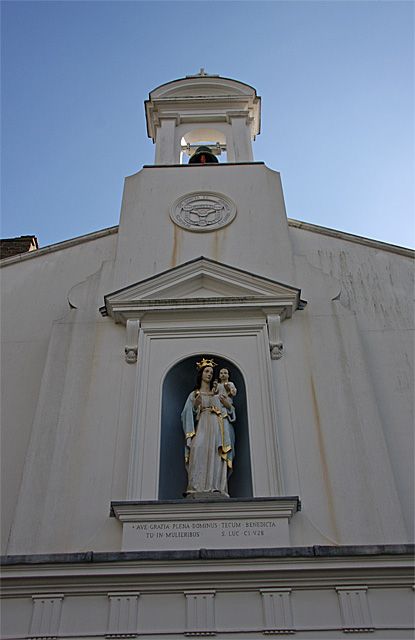

Stop three. Saint Mary's.
It does not look like a church, and that is the whole point. It was built in eighteen sixteen, when a Catholic church in England was a recent and nervous freedom, and it is one of the earliest built in London after the Reformation. So it keeps its head down. Only the bell tower and the statue of the Virgin and Child give it away, and both of those were added in the eighteen fifties, once it was safe to be obvious.
The man who built it was a refugee. Jean-Jacques Morel was a French priest who fled the Revolution in seventeen ninety two, arrived in England with nothing, and by seventeen ninety six was looking after the French Catholics who had washed up on this hill for the same reason. He raised the money, and the chapel went up in under a year and opened in August eighteen sixteen.
That is the fact worth carrying for the rest of the walk. Hampstead's reputation is poets and money. But this church exists because a village on a hill absorbed a few hundred frightened foreigners and let them build something.
Two names in the register. Graham Greene was married here in nineteen twenty seven, having converted in order to do it, which is where a great deal of his writing starts. And during the Second World War, when the Free French were running their war from London, Charles de Gaulle worshipped here.
Free, and usually open. It is very small and very quiet, and there is a good chance you will be the only one in it.
Keep going up Holly Walk. On your left, watch for a squat little building set in the wall: that is the old watch house, where the night watchman sat before anybody had thought of police. The lane opens out at the top. Two minutes.
51.55690, -0.18029 · where this is on a map